Did you buy an expensive 100W fast charger only to find your laptop charging frustratingly slow? If your charger has plenty of output but the battery fills up slower than expected, your cable might be the culprit. USB-C cables look identical on the outside, but what is happening on the inside?
Key Takeaways
- Standard 3A cables support up to 60W (20V/3A) without an E-Marker chip.
- High-power charging at 100W and 240W (5A) requires a built-in E-Marker chip in the connector.
- Plugging a non-E-Marker cable into a 100W charger automatically limits output to 60W to prevent overheating.
- Charging wattage (W) and data transfer speeds (Gbps) are independent specs, so check both before buying.
Why You Get Capped at 60W Even on a 100W Charger
Even if they look identical, USB-C cables are divided by internal current rating: 3A (ampere) and 5A cables. Standard consumer cables are engineered to carry a maximum current of 3A (60W at 20V).
When you connect a 3A cable between a 100W charger and a laptop, the charger automatically throttles its output to 60W (20V/3A) to prevent cable overheating and fire hazards. Even if the charger can supply 100W, the cable bottleneck locks the output at 60W.
What Is an E-Marker Chip, and Why Does 5A Require It?
To safely carry currents above 3A—specifically 5A for 100W and 240W—a miniature chipset called an “E-Marker” (Electronic Marker) must be integrated into the connector.
The E-Marker chip acts as an ID card. It uses the cable’s CC (Configuration Channel) line to transmit current rating (5A) and voltage specifications to both the charger and the connected device in real time. Without this chip, devices assume the cable cannot safely handle high power and fall back to 60W safe mode for hardware protection.
USB-C Power Ratings and E-Marker Requirements at a Glance
Under USB-IF (USB Implementers Forum) standards, cable power specifications are divided into Standard Power Range (SPR) and Extended Power Range (EPR). Official certified specifications primarily center around 60W and 240W tiers.
| Category | Max Current | Max Voltage | Max Supported Power | E-Marker Required |
|---|---|---|---|---|
| Standard Cable (SPR) | 3A | 20V | 60W | No |
| High-Power Cable (SPR) | 5A | 20V | 100W | Yes |
| Extended-Power Cable (EPR) | 5A | 28V / 36V / 48V | 140W ~ 240W | Yes |
While some products are marketed as “140W dedicated cables,” the official USB PD 3.1 EPR standard certifies cables based on 240W (48V/5A) capabilities.
Does a 240W Cable Mean Faster Data Transfer?
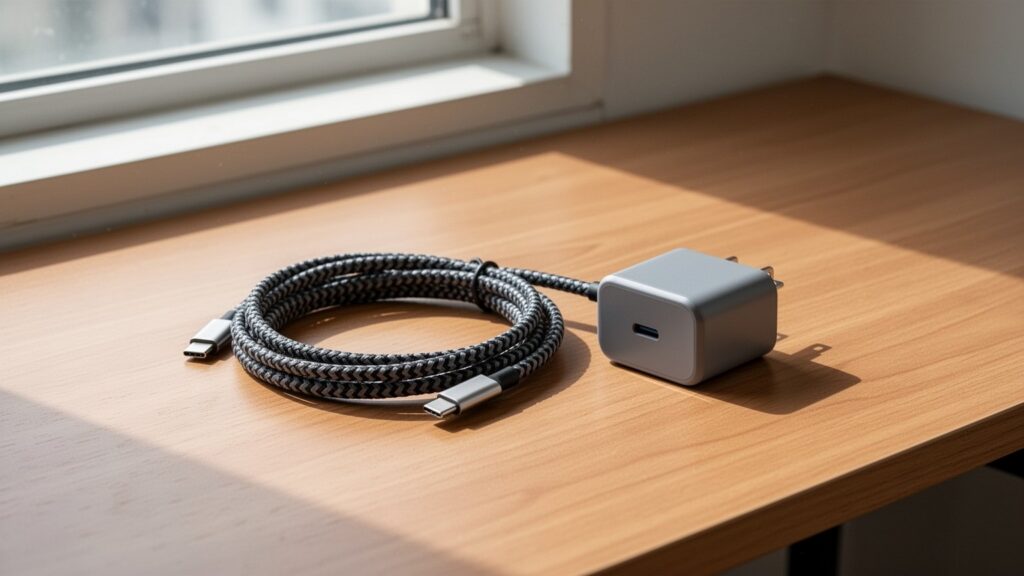
High charging capacity does not guarantee fast data transfer speeds. Even if an E-Marker cable supports 240W charging, data speeds remain capped at basic USB 2.0 (480 Mbps) if it lacks dedicated high-speed data wiring.
Conversely, a cable limited to 60W (3A) charging still requires an E-Marker chip if it supports high-speed data protocols like USB 3.2 Gen 2 (10 Gbps) or USB4 (40 Gbps and above) to communicate its capabilities to devices. Power and data transmission are independent specifications, so check both before purchasing.
When shopping for a cable to charge your laptop or high-power device, look for “100W/240W supported” or “E-Marker equipped (5A)” in the product specs first.
답글 남기기