When internet speeds slow down or gaming starts to lag, replacing your ethernet cable is usually the first fix that comes to mind. Search any retail site and you will see “ultra-high-speed premium” Cat 7 cables everywhere. Will plugging in a more expensive cable with a higher number actually make your home internet faster?
Key Takeaways
- Bandwidth: Cat 6 supports 250 MHz (up to 10 Gbps within 55 m), while Cat 7 supports 600 MHz (10 Gbps).
- Grounding issues: Cat 7 uses shielded wiring (STP) that can act like an antenna, causing noise and lag on ungrounded home routers.
- Speed bottlenecks: If your internet plan and router ports max out at 1 Gbps, a higher-tier cable will not increase your speeds.
- Price: Cat 7 is 2 to 4 times more expensive per meter, running about $3.40 to $3.80 (4,500 to 5,090 KRW) compared to about $0.70 to $2.00 (950 to 2,700 KRW) for Cat 6.
Bandwidth and Speed Differences by Specification
The category number on an ethernet cable designates its transmission standard. A higher number indicates wider bandwidth—the total width of the digital road your data travels on.
Here is how the performance breaks down across standards:
| Standard | Bandwidth | Max Speed | Effective Home Distance |
|---|---|---|---|
| Cat.5e | 100MHz | 1Gbps | Up to 100m |
| Cat.6 | 250MHz | 1Gbps (10Gbps) | 100m (10Gbps up to 55m) |
| Cat.6a | 500MHz | 10Gbps | Up to 100m |
| Cat.7 | 600MHz | 10Gbps | Up to 100m |
Keep in mind that specifications can differ slightly across documentation. While most standards rate Cat 7 at 10 Gbps, some technical references cite speeds up to 40 Gbps over shorter runs. In a typical home environment, looking at the distance supported at 10 Gbps is more than enough.
Why Cat 7 Can Actually Cause Drops at Home
Cat 7 ethernet cables use an STP (S/FTP) construction with metal shielding to block heavy electromagnetic interference. For this shield to function correctly, the connected equipment on both ends and the wall jacks must have a complete, grounded setup.
However, consumer home routers are mostly encased in plastic and lack grounding circuitry. The same is true for standard wall jacks and typical desktop network cards.
An ungrounded shielded cable cannot discharge incoming electromagnetic noise. Instead, it creates an “antenna effect,” absorbing stray interference. Connecting an industrial shielded cable to an ungrounded home setup can cause signal noise, latency spikes, and intermittent disconnects.
Upgrading Your Cable Won’t Help if Your Plan and Router Are 1 Gbps
Network throughput is always throttled by the slowest segment in the path. Opening an eight-lane highway does not eliminate traffic if every car still has to squeeze through a single toll booth.
Over 90% of home connections operate on broadband plans between 100 Mbps and 1 Gbps. Most consumer router ports and computer network cards are also built to negotiate speeds up to 1 Gbps.
When the gateway itself—your internet plan and networking gear—is capped at 1 Gbps, plugging in a 10 Gbps cable will never push your real throughput past 1 Gbps.
Why Cat 6 Is the Smarter Choice for Value and Compatibility
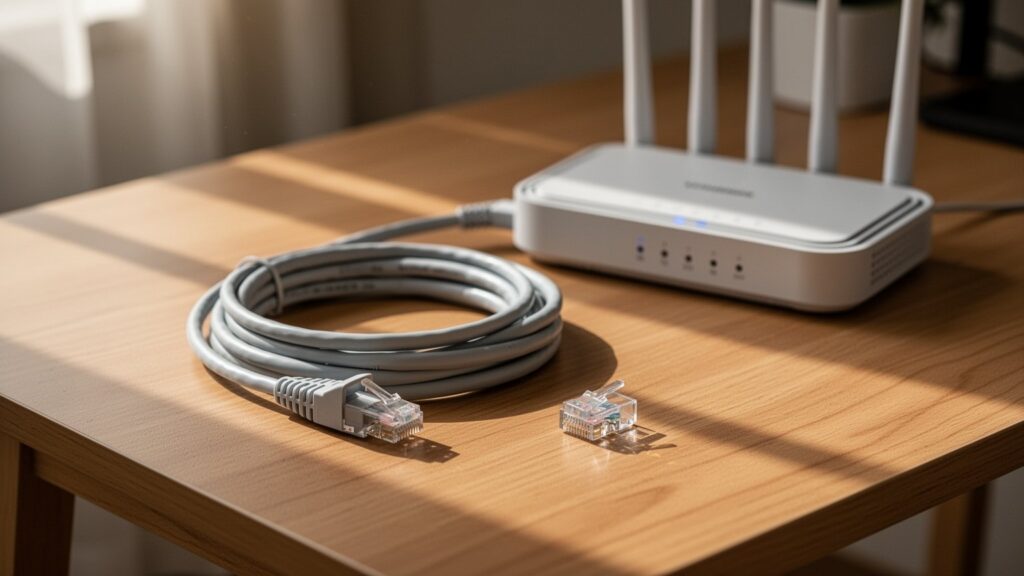
Unshielded twisted pair (UTP) Cat 6 cable is the ideal choice for residential use because it requires no grounding. Run distances between rooms in most homes fall well within 55 meters, allowing Cat 6 to reliably deliver up to 10 Gbps.
The price difference is also substantial. Retail prices for pre-terminated 1-meter patch cables show a clear gap:
- Cat.6 UTP Cable (1m): About $0.70 to $2.00 (950 to 2,700 KRW)
- Cat.7 Shielded Cable (1m): About $3.40 to $3.80 (4,500 to 5,090 KRW)
Cat 7 costs 2 to 4 times more than Cat 6. Furthermore, many retail Cat 7 cables fitted with standard plastic RJ-45 connectors are purely marketing products. True Cat 7 standards specify proprietary GG45 or TERA connectors, meaning many consumer-grade Cat 7 cables have never actually been certified to deliver 600 MHz bandwidth.
For a home network, skip expensive Cat 7 cables and their potential noise issues. A standard Cat 6 UTP cable costing around a dollar or two per meter is all you need.
Related Articles
- Formatting USB: How to Choose Between NTFS, exFAT, and FAT32
- How to Disable the Caps Lock Key in One Minute Using Microsoft PowerToys