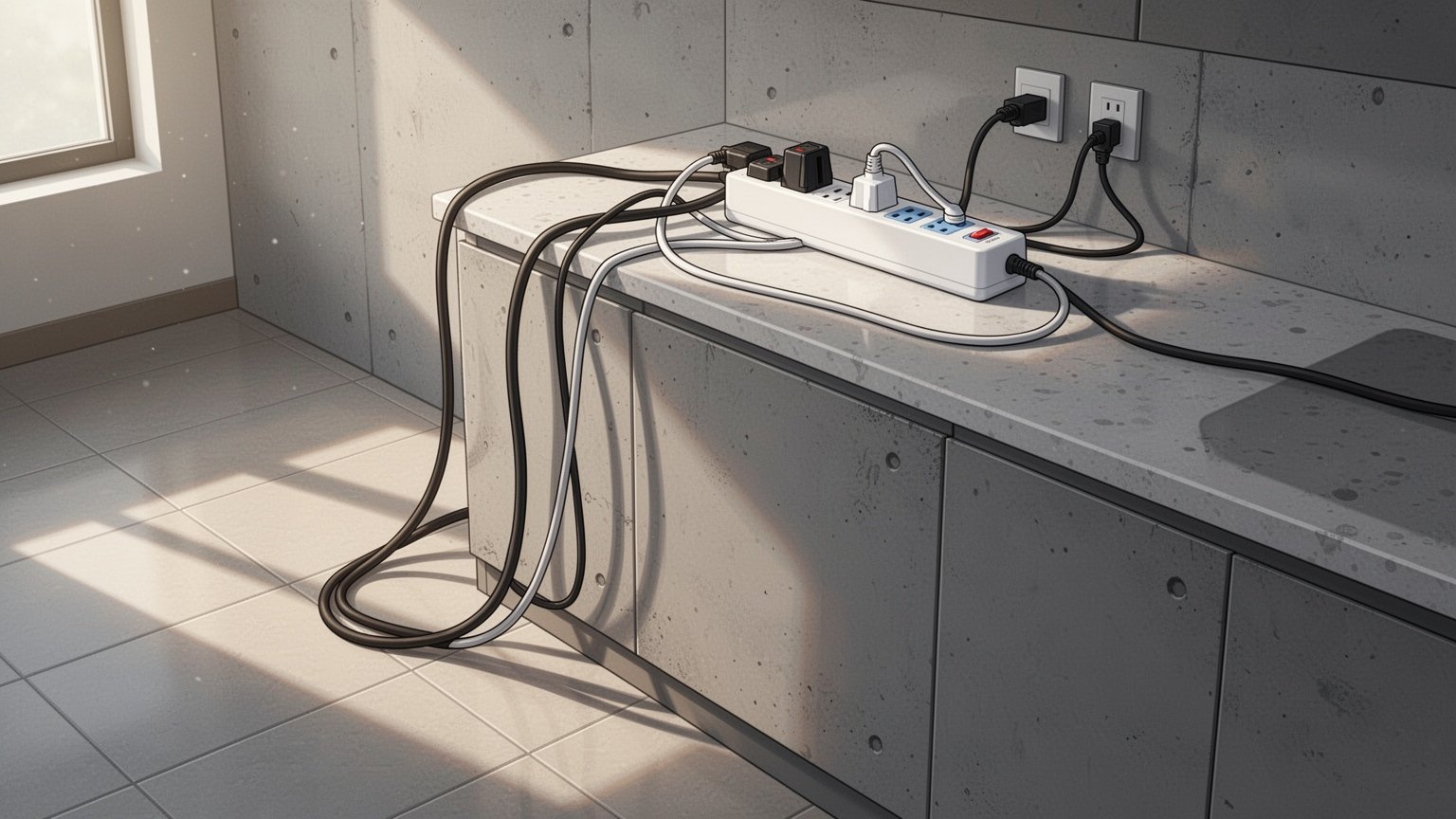
When there is an open socket on a power strip in your living room or kitchen, it is easy to plug in an air fryer or air conditioner without a second thought. A strip with 5 or 6 outlets seems spacious enough, but why do power cords get hot or circuit breakers trip?
Quick Overview
- Calculate power strip capacity with ‘V × A’; a 16A 250V model handles up to 4,000W.
- For fire safety, keep continuous load below the 80% threshold of 3,200W (or 70% / 2,800W for heating and motor-driven appliances).
- Running a standing AC (up to 2,800W) and an air fryer (up to 1,800W) simultaneously reaches 4,600W, instantly exceeding the safe limit.
- High-power appliances should always plug directly into wall outlets; if an extension is necessary, use a dedicated 4,000W heavy-duty strip with 2.5SQ wiring and a built-in circuit breaker, connecting only one device.
How to Calculate Wattage Capacity from ’16A 250V’ on a Power Strip
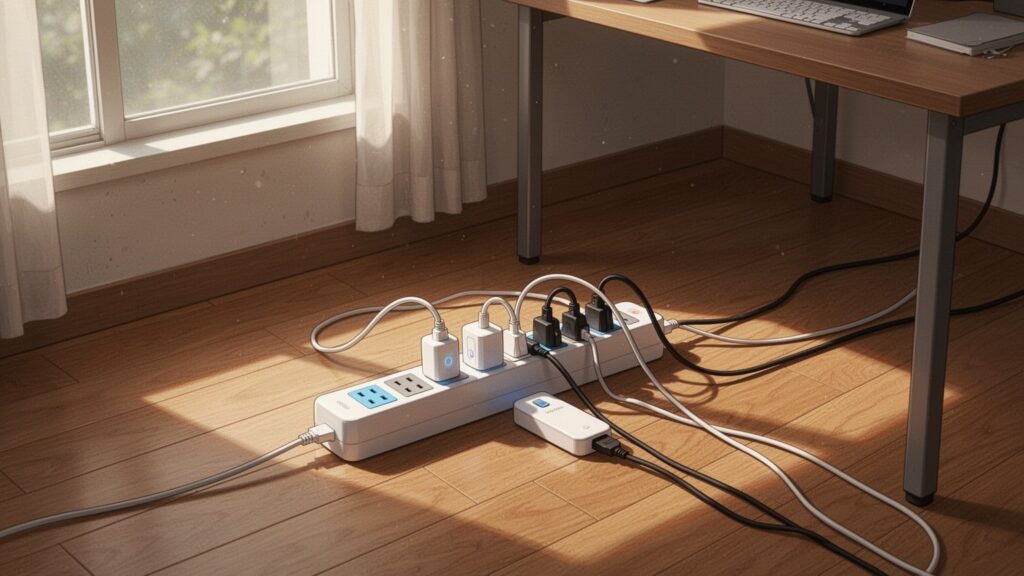
You can calculate a power strip’s maximum capacity using the formula printed on the back: Rated Voltage (V) × Rated Current (A). A standard 16A 250V power strip handles up to 4,000W (250V × 16A). On the other hand, older or low-capacity models rated at 10A 250V top out at just 2,500W.
The key rule is that you should never use 100% of that 4,000W ceiling. To account for heat generation and sudden power surges, experts recommend staying within 80% of total capacity—around 3,200W to 3,300W. For appliances with heating elements or electric motors, keep total usage under 70% (roughly 2,800W) for optimal safety.
| Rating Specification | Maximum Capacity | Recommended Safety Limit (80%) | Motor & Heating Appliances (70%) | Recommended Wire Gauge |
|---|---|---|---|---|
| 10A 250V (Older/Low-capacity) | 2,500W | Under approx. 2,000W | Under approx. 1,750W | 1.0SQ (1.0 mm²) |
| 16A 250V (Standard Strip) | 4,000W | Under approx. 3,200W–3,300W | Under approx. 2,800W | 1.5SQ (1.5 mm²) |
| 16A 250V (Heavy-duty with Breaker) | 4,000W | Under approx. 3,200W–3,300W | Single device recommended | 2.5SQ (2.5 mm²) or thicker |
Whether a power strip has 2 outlets or 6, the total allowable load supported by the single cord is the same: 4,000W. Just like a bridge’s gross vehicle weight rating, the combined wattage of all connected devices must not exceed the limit.
What Happens When You Run an AC and an Air Fryer at the Same Time
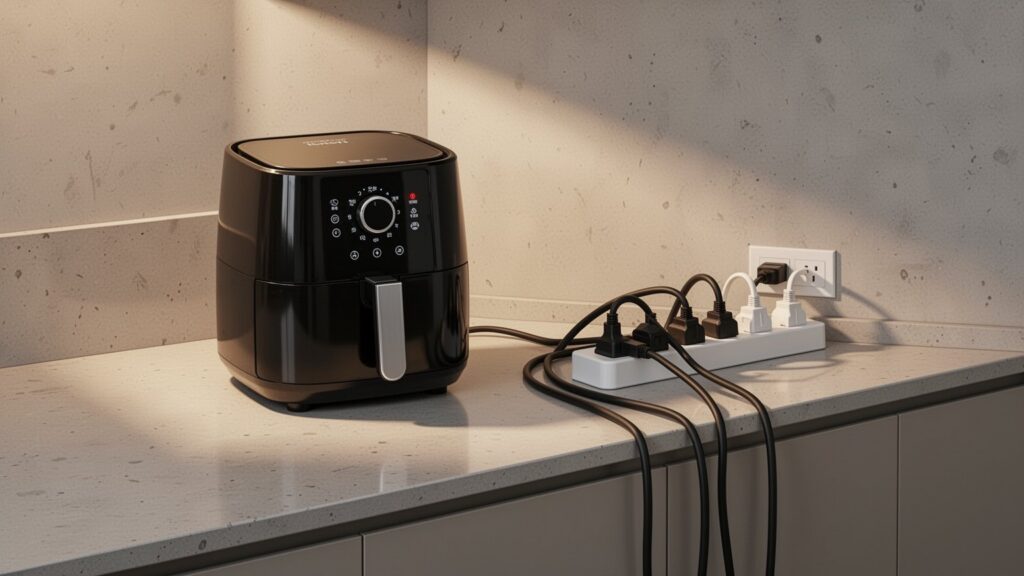
Everyday household appliances pull more power than many expect. A standing air conditioner consumes 2,000W to 2,800W, while a large air fryer pulls 1,500W to 1,800W. Plugging both into a single 16A power strip and operating them simultaneously drives total demand to 3,500W–4,600W, quickly blowing past the safe threshold of 3,200W.
When current exceeds safety ratings, electrical resistance causes rapid heat accumulation, melting the outer insulation and risking a short-circuit fire. In a demonstration by the Busan Fire and Disaster Headquarters, connecting a single air conditioner to a coiled 10A power strip caused wire temperatures to reach 130°C (266°F) and catch fire in just 7 minutes and 30 seconds.
According to data from the Korea Consumer Agency (CISS), 387 safety accidents related to power strips and outlets were reported over a five-year period from 2020 to 2024. Electrical issues like shocks, ground faults, and short circuits accounted for 44.7% (173 cases), while fire and overheating made up 25.1% (97 cases), with residential homes accounting for 84.6% of all occurrences.
How to Choose the Right Heavy-Duty Power Strip for High-Wattage Appliances
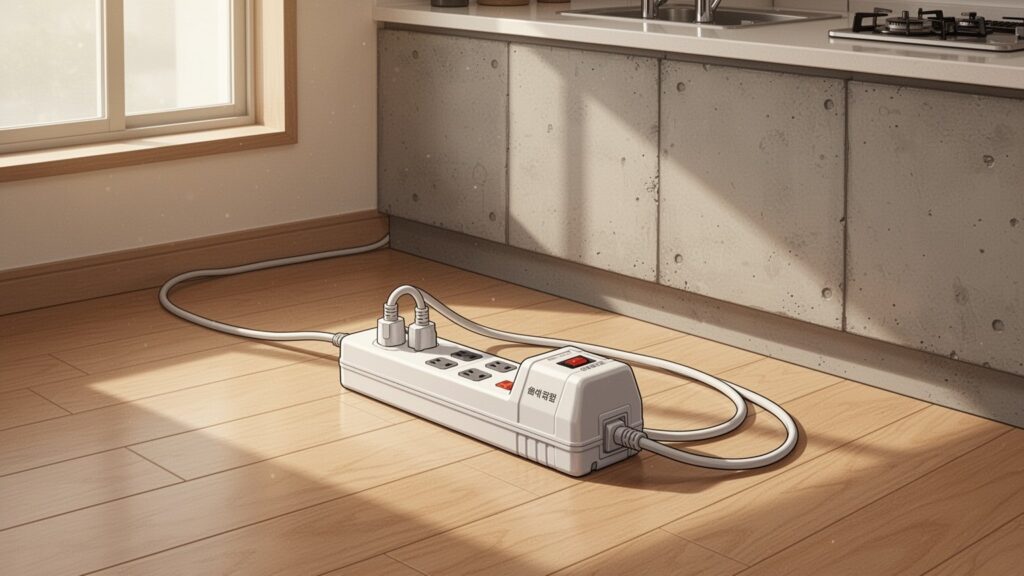
High-draw appliances—such as standing air conditioners, induction cooktops (1,800W–3,400W), and electric pressure rice cookers (1,100W–1,400W)—should always be plugged directly into a wall receptacle. If distance requires an extension, you must choose a specialized heavy-duty power strip.
Standard power strips typically use 1.5SQ (1.5 mm²) wiring, but heavy-duty versions use thicker 2.5SQ (2.5 mm²) or larger cords to suppress heat. Look for units equipped with an overload switch, a ground-fault circuit interrupter that shuts off power within 0.03 seconds, grounded contacts, and a flame-retardant enclosure.
Because wattage ratings differ depending on the brand and active operating mode, make it a habit to check the specification label on each appliance. Electrical safety authorities also advise replacing power strips every 1 to 2 years to avoid loose contact points and deteriorated internal insulation.
Check your power strips today for a ’16A’ rating, make sure cords are uncoiled and untangled, and always plug major appliances like air conditioners directly into a wall outlet.